
The short answer: pick the material for the weather the furniture will really sit in, size every piece for the space with room left to walk, and check the frame and cushions before you fall for a colour. In Malaysia, a covered patio and an open garden are two different climates. Furniture that thrives in one can fail in the other, and most buying regrets come from shopping for the photo instead of the spot.
This guide walks through the decision in order: space first, then use, then materials, then the checks that separate a set you keep for years from a set you replace after two monsoons.
Step 1: Measure the space before you look at furniture
Start with a tape measure, not a catalogue. The three common Malaysian outdoor spaces ask for different things.
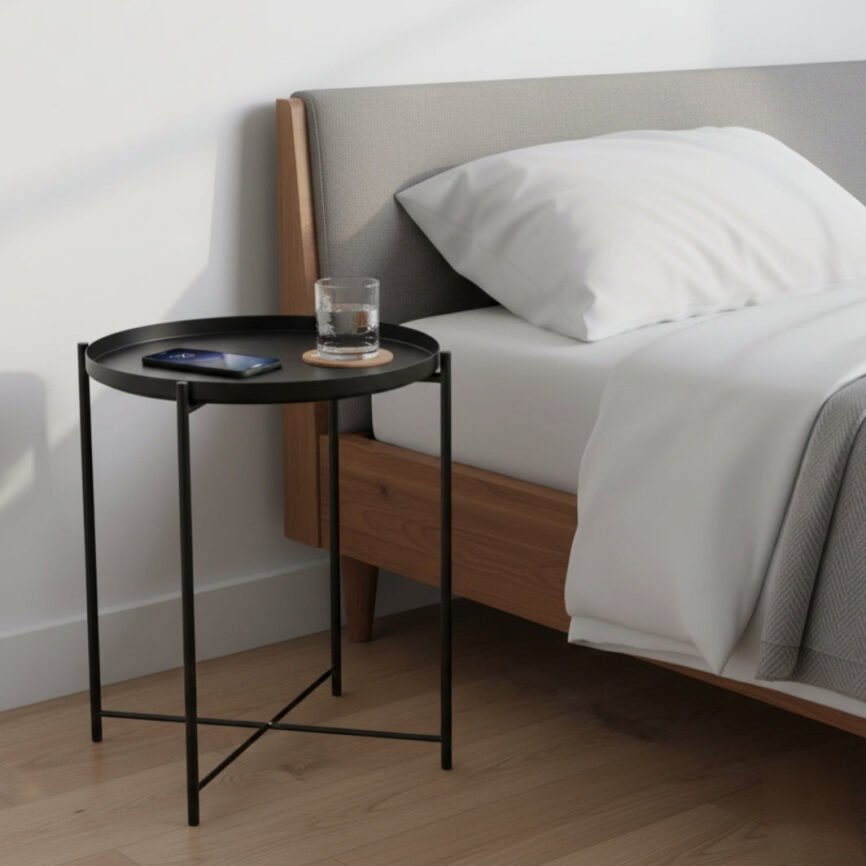
A condo balcony is narrow, with a sliding door that needs room to open and a railing you cannot block. Most balconies take a two-seat bistro set or a pair of lounge chairs with a small side table, and nothing more. Weight matters too: on high floors, wind catches light furniture, and pieces get carried through the flat, so check lift and doorway widths.
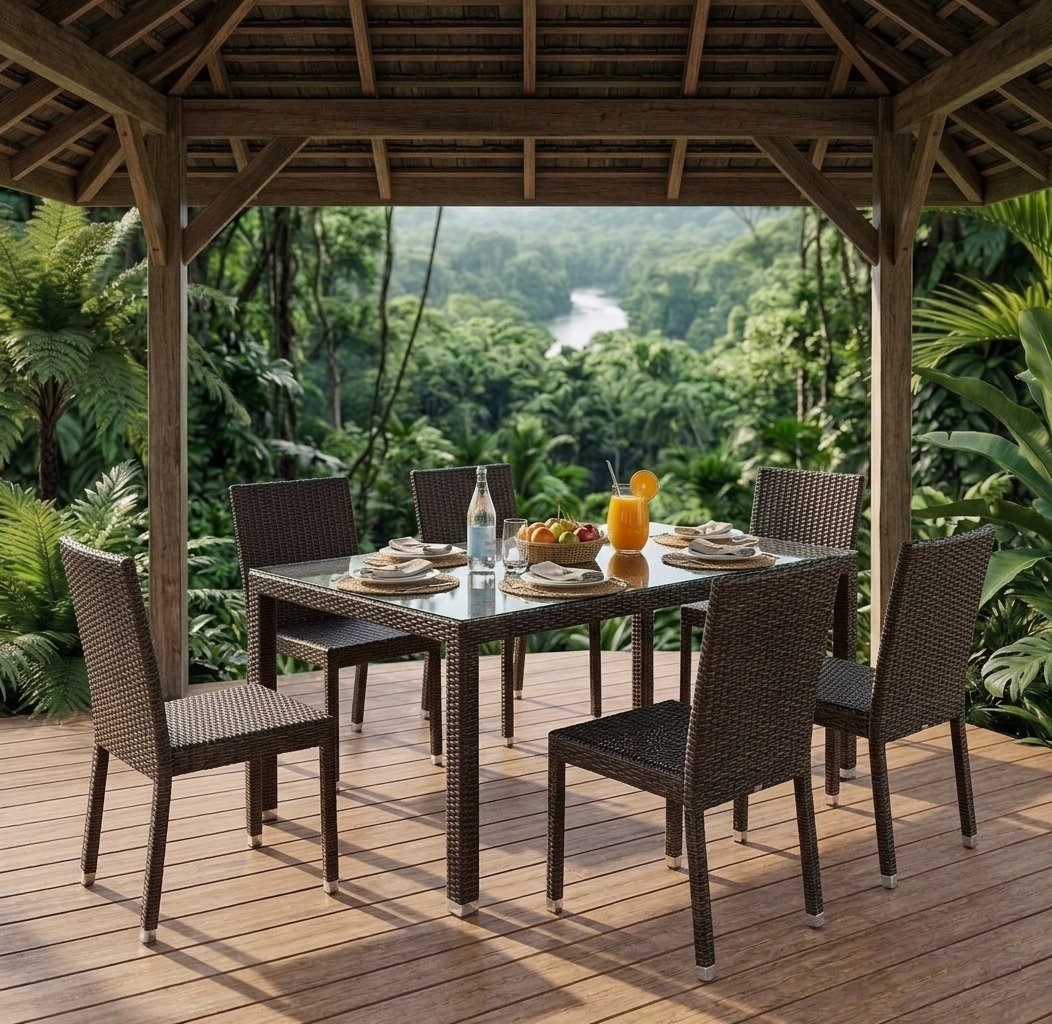
A patio or terrace is usually covered or partly covered. This is the flexible space. It can hold a dining set, an outdoor sofa set, or both in zones if the floor area allows. The roof line is the key measurement, because it decides which pieces sit in rain and which stay dry.
A garden is fully exposed. Sun all morning, rain all afternoon, and ground that stays damp. Furniture here needs the toughest materials, flat and stable feet for grass or decking, and a plan for drainage so legs are not standing in water after a storm.
Whichever space you have, mark the furniture footprint on the ground with tape before you buy, then walk around it. As a rule of thumb, leave roughly 90 cm for walking routes and about 60 cm behind dining chairs so they can be pulled out and pushed back without scraping. If the taped outline already feels tight, the real furniture will feel tighter.
Step 2: Decide how the space will actually be used
Buy for your ordinary week, not for the one big gathering a year. If the space hosts family dinners three times a week, a proper dining set earns its footprint. If it is a morning coffee and evening reading spot, two good lounge chairs and a side table beat a dining set that becomes a storage shelf.
For dining, count your regular seats honestly. A four-seater that gets used daily is a better buy than an eight-seater that crowds the patio for eleven months to serve one Raya open house. Extra guests can be covered with stackable spare chairs kept indoors.
For lounging, think about shade. A sun lounger in a garden with no shade will sit empty through the hottest hours. Place loungers and daybeds where a tree, a parasol or the roof edge gives cover for part of the day, and be honest about whether you will move cushions in and out.
The three spaces at a glance
| Space | Fits well | Watch out for |
|---|---|---|
| Condo balcony | Two-seat bistro set, a pair of lounge chairs, a small side table | Door swing, railing space, wind on high floors, lift and doorway sizes |
| Covered patio | Four to six-seat dining set, outdoor sofa set, a lounger at the sunny edge | The roof line: pieces just outside it take full rain |
| Open garden | Teak or aluminium dining and lounge sets, daybeds, swings | Standing water after storms, uneven ground, all-day sun on cushions |
If your home has more than one of these spaces, furnish the one you will use daily first. The second space can wait for the next budget round, and a half-finished main space helps nobody.
Step 3: Match the material to the exposure
This is the decision that decides how long the furniture lasts. Work through it by asking one question: how much direct rain will this piece take?
| Material | Best placed | In full rain | Care it needs |
|---|---|---|---|
| A-grade teak | Garden, patio, poolside | Holds up well; the surface silvers over time if left unoiled | Oil it to keep the brown colour, or leave it and wash; sanding and re-oiling restores it |
| Powder-coated aluminium | Balcony, patio, garden | Will not rust like steel, though it can pit in coastal air; light enough to move before a storm | Wash down; touch up chips in the coating before they spread |
| Stainless steel | Patio, garden, coastal homes | Resists rust well; coastal air calls for a higher grade | Wipe salt spray off; polish marks with a soft cloth |
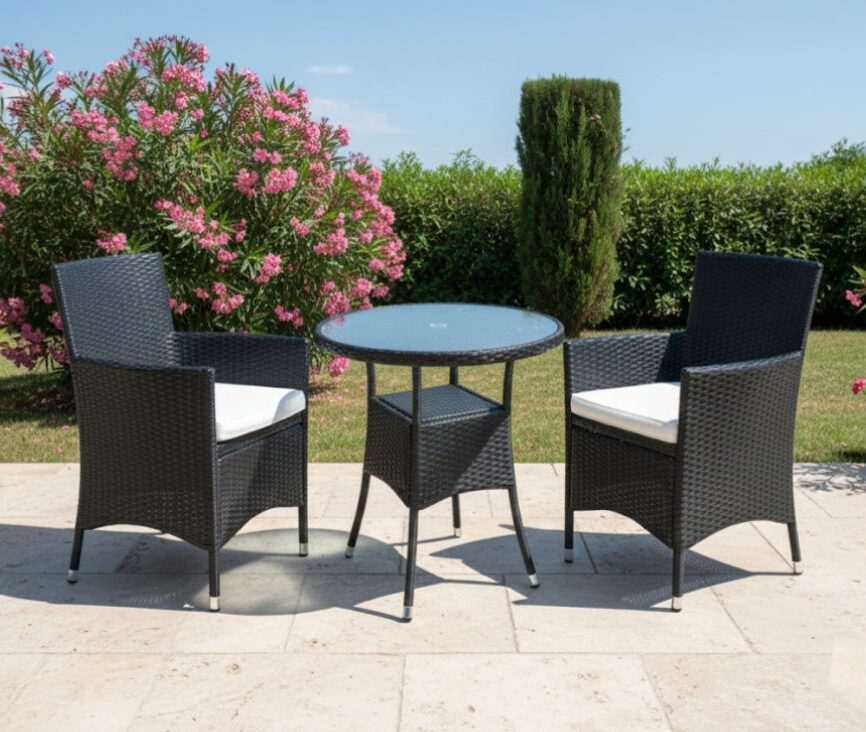
| Viro wicker (PE rattan) on an aluminium frame | Patio, garden | The weave handles rain; the frame underneath decides the lifespan | Rinse dust out of the weave; store or cover the cushions |
| Natural rattan | Covered patio only | Absorbs water, then mould and splitting follow | Keep it dry; bring it under full cover in the monsoon |
| Powder-coated mild steel | Covered patio, balcony | The coating protects it; deep scratches can rust | Touch up scratches early; keep it out of standing water |
Two points in that table matter more than the rest. First, teak is not one thing. Mature, A-grade teak has the dense, oil-rich grain that shrugs off rain. Young teak is a different timber in practice: it can bend and crack as it dries. Samz outdoor pieces use A-grade teak sourced from Indonesian partners, and the care route is simple because a worn top can be sanded back and re-oiled instead of replaced.
Second, look past the weave on any rattan or wicker piece. The synthetic weave, such as the Viro wicker woven in-house at our Shah Alam workshop, is made for wet weather. The frame inside it is what fails first on cheap sets, so ask what the frame is made of and check the joints by hand.
Mixed pieces follow the same rule. A teak top on a powder-coated aluminium frame is a sound combination for a garden dining table, because each material is doing the job it is good at: the timber takes the weather and the daily knocks, the metal keeps the weight down and will not rust like steel. What you want to avoid is the reverse logic, where a weak material is placed in the wettest role for the sake of a look. If a set mixes materials, ask which part gets the rain and whether that part is the strong one.
Step 4: Check the frame, the joints and the feet
Showroom checks take five minutes and tell you more than a product listing does.
- Lift one corner. A well-built frame feels rigid. Twist or wobble at this stage only grows with use.
- Look at the joints. On metal frames, welds should be continuous, not spot-tacked and filled. On timber, joints should close tight with no gaps you can slide a coin into.
- Check the feet. Glides or caps protect both the furniture and your tiles. On a balcony, rubber feet also stop the scrape marks that upset condo management.
- Sit in it properly. Full weight, lean back, shift around. Listen for creaks and feel for flex in the arms.
- Ask about the cushion inners. Quick-dry foam and removable covers are worth paying for, covered in the next section.
- Ask what can be repaired. Frames that can be welded, covers that can be replaced and timber that can be re-oiled all extend the life of a set. A seller who repairs what they sell is telling you something about how it was built.
Step 5: Get the cushions and fabric right
Cushions usually fail before frames do in Malaysia. Heat, humidity and sudden rain punish the wrong foam and fabric, and mouldy cushions are a common reason good frames end up at the curb.
Choose outdoor fabrics made for wet climates, such as olefin, which dries fast and resists mould and fading. Inside, quick-dry foam lets water pass through instead of holding it like a sponge. Standard indoor foam in an outdoor cushion will stay damp for days and soon start to smell.
Covers should unzip. If a cover cannot come off, it cannot be washed, and in this climate it will need washing. Keep a simple routine: brush off leaves and dust weekly, wash covers when they start to look grey, and store cushions under cover during the heaviest monsoon weeks if you have the space.
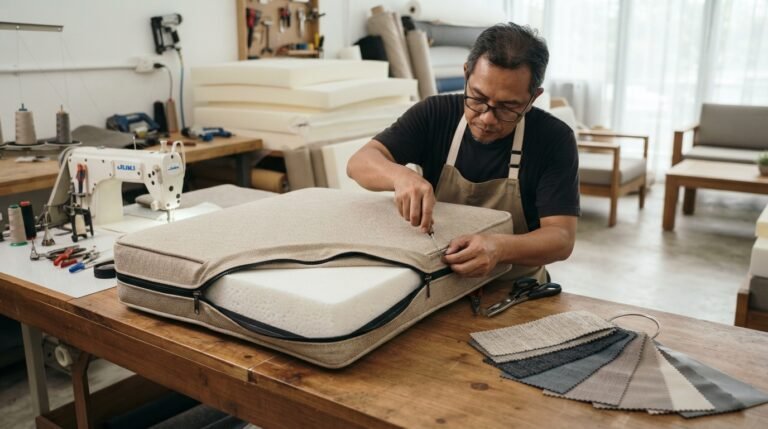
When cushions do wear out, the frame rarely needs to go with them. New cushion covers and fresh foam, cut to your existing frames, bring a set back for a fraction of a replacement. That is a standard job for our cushion cover and upholstery service, and our guide to outdoor furniture repair in Malaysia covers the full list of what can be saved.
Step 6: Know what the price is paying for
Outdoor furniture prices in Malaysia spread widely, and the gap usually traces back to five factors:
- Material grade. A-grade mature teak costs more than young teak or mixed timber, and the difference shows up years later, not in the showroom.
- Frame metal and thickness. A thick-walled aluminium frame costs more to make than a thin one and stays rigid far longer.
- Fabric and foam. Genuine outdoor fabric and quick-dry foam add cost at purchase and save a replacement later.
- Size and customisation. Bigger pieces and made-to-measure sizes use more material and more workshop time.
- Delivery and access. Distance, carry-up floors and disposal of the old set all form part of the real cost.
A cheap set that needs replacing after two monsoons costs more than a sound set bought once. Judge price per year of use, not price on the tag.
Step 7: Buying made to order in Malaysia
Standard sizes do not fit every balcony or patio, which is why Samz works made to order: every order is customised, with sizes, materials and colours chosen per client, and no stock held. The trade-off is time. Customised orders take 45 to 70 days, so order ahead of festive seasons and house moves rather than the week before.
Finishes for teak run to Natural Light, Water Base, Dark Natural, Black, Dark Brown and Light Walnut. Powder coating for metal frames and bases comes in Black, White, Dark Grey and Brown. If you are working to a fixed gap, a doorway width or a matching piece you already own, our custom design service starts from your measurements.
Every Samz piece carries a 3-year warranty for domestic use, covering manufacturing and structural defects. Delivery covers Selangor and Kuala Lumpur through to Johor, Penang, Perak, Melaka, Pahang, Kedah and Kelantan, and Klang Valley delivery is free on orders over RM 8,000.
Step 8: Plan the delivery before the furniture is ready
Outdoor pieces are bulky, and the last ten metres cause most of the trouble. Measure the tightest point on the route in: the lift, the stairwell turn, the garden gate. A two-metre sofa that cannot make the turn is a problem nobody wants on delivery day, so check the route with a tape measure at the ordering stage.
If your building has no lift, carry-up is charged per floor and confirmed in your quote, so there are no surprises on the day. If the old set needs to go, disposal can be arranged as an add-on before the delivery date is set, rather than leaving a worn set sitting in the garden while you work out what to do with it. Send the access details with your order and the delivery team will plan around them.
Where to start looking
Browse the full outdoor furniture collection once you know your measurements and exposure. Balcony owners usually start with bistro and patio lounge sets, dining households with outdoor dining sets, and covered patios with outdoor sofa sets or sun loungers and daybeds for the sunny edge. For the woven look, see the rattan and wicker furniture range, and check your shortlist against our notes on how long outdoor furniture lasts in Malaysia before you commit.
Frequently asked questions
What is the best material for outdoor furniture in Malaysia?
For fully exposed spots, A-grade teak and powder-coated aluminium are the safest pair: teak handles rain and sun with simple care, and aluminium will not rust like steel and stays light enough to move. For covered patios, Viro wicker on an aluminium frame and stainless steel both do well. Natural rattan belongs under a roof.
Can outdoor furniture stay outside during the monsoon?
Frames in teak, aluminium or stainless steel can stay out, provided they are not standing in pooled water. Cushions are the weak point: bring them under cover during the heaviest weeks, or choose quick-dry foam and olefin covers and store them on edge so water drains.
How much space do I need around an outdoor dining set?
As a rule of thumb, allow about 60 cm behind each chair for pulling out, plus roughly 90 cm on any route people walk while others are seated. For a four-seater table of about 120 cm, that means a patio zone of roughly 3 m by 3 m feels comfortable rather than squeezed.
How long should outdoor furniture last in Malaysia?
It depends on the material and the exposure more than on the brand. Our separate guide on how long outdoor furniture lasts in Malaysia breaks the expectations down by material, including what shortens and extends each lifespan.
Can worn outdoor furniture be repaired instead of replaced?
Often, yes. Frame repairs, new cushion covers, fresh foam, full re-upholstery and teak cleaning, sanding and re-oiling cover most of the ways a set ages. Send a photo of the piece and our maintenance and repair service will give you an honest answer on whether it is worth saving.
Can I order a non-standard size for a small balcony?
Yes. Samz pieces are made to order, so table widths, sofa lengths and lounger sizes can be adjusted to your measurements. Send the measurements with your enquiry and the quote will be built around them.
Talk to us before you buy
If you would rather talk it through, send us your space measurements and a photo of the spot on WhatsApp. We will tell you honestly what fits, which materials suit your exposure, and what it would cost.

Mueed
Related articles