Home » Shop » Living room » Sideboards
Sideboards
Sideboards
There is a moment in every home where the storage runs out before the stuff does. The kitchen drawers are full. The dining table has become a permanent landing zone for mail, keys, and things that do not have a home. The living room has that one corner where bags, chargers, and paperwork collect into a pile you keep meaning to deal with but never quite do. A sideboard fixes this. Not by hiding the mess in a cupboard you forget about, but by giving everything a proper place in a piece of furniture that actually looks like it belongs in the room. A good sideboard does double duty: closed storage behind doors and drawers for the things you want out of sight, and a flat surface on top for the things you want on display. At Samz Design, we build sideboards from solid teak wood in our Shah Alam workshop. Some with woven rattan detailing. Some with sliding louver doors. All made to your exact width, depth, and finish. Because the wall you are looking at right now, the one where a sideboard would solve three problems at once, is not a standard size. So why would a standard sideboard fit it?
What a Sideboard Actually Does (and Why Most Homes Need One)
People search for sideboards without always knowing what they are looking for. Some call it a buffet. Some call it a credenza. Some just know they need “that long cabinet thing” for the wall opposite the dining table. The terms overlap, and the differences are smaller than the furniture industry makes them seem. Here is what matters: a sideboard is a low, long storage piece that sits against a wall. It is shorter than a wardrobe, longer than a chest of drawers, and shallower than both. The typical height is between 75 and 85 cm, which puts the top surface at exactly the right level for serving food, displaying objects, or setting down a lamp. In a dining room, the sideboard holds tableware, serving dishes, table linens, and bottles you bring out for guests. In a living room, it stores books, board games, paperwork, and the miscellaneous items that every household accumulates. In a hallway, it catches keys, wallets, and bags the moment you walk through the door, with a mirror or artwork hung above it. The reason sideboards work so well in all these rooms is the proportions. They are wide enough to make visual impact on a wall, low enough that they never dominate the room, and deep enough to store real objects without poking out into the walkway. A well-proportioned sideboard makes a room feel furnished and finished. An empty wall makes the same room feel like someone has not moved in yet.
Three Solid Teak Sideboards, Three Different Characters
We build three designs. Each one uses a different construction detail that changes how it looks, how it feels, and which rooms it works best in. All three are fully customisable.
Rattan Berlin Teak Wood Sideboard
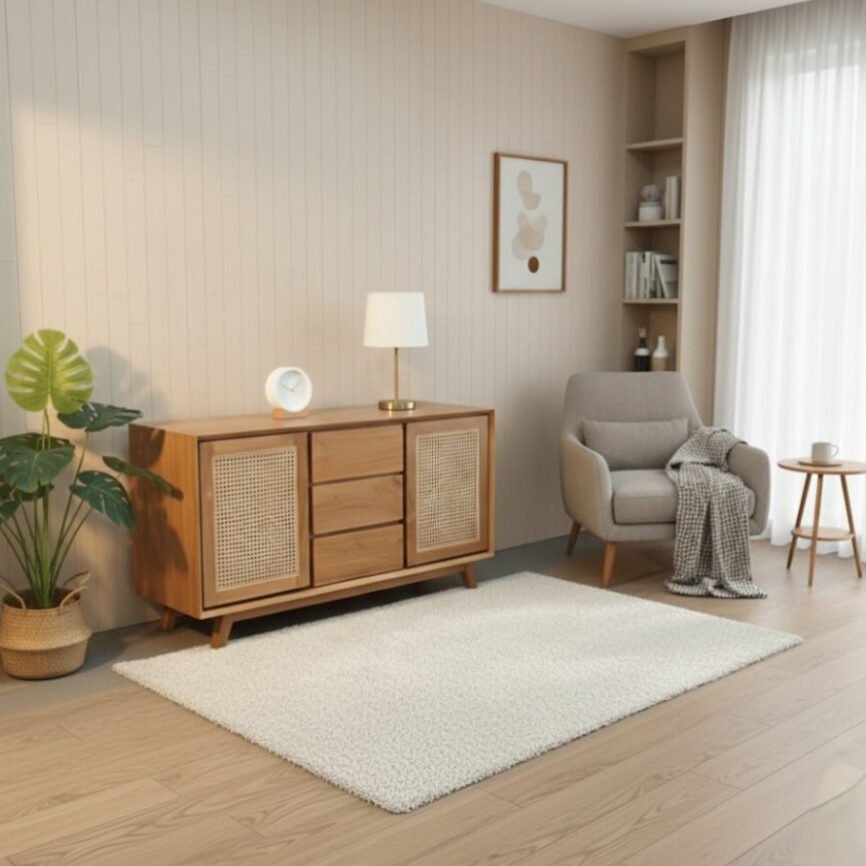
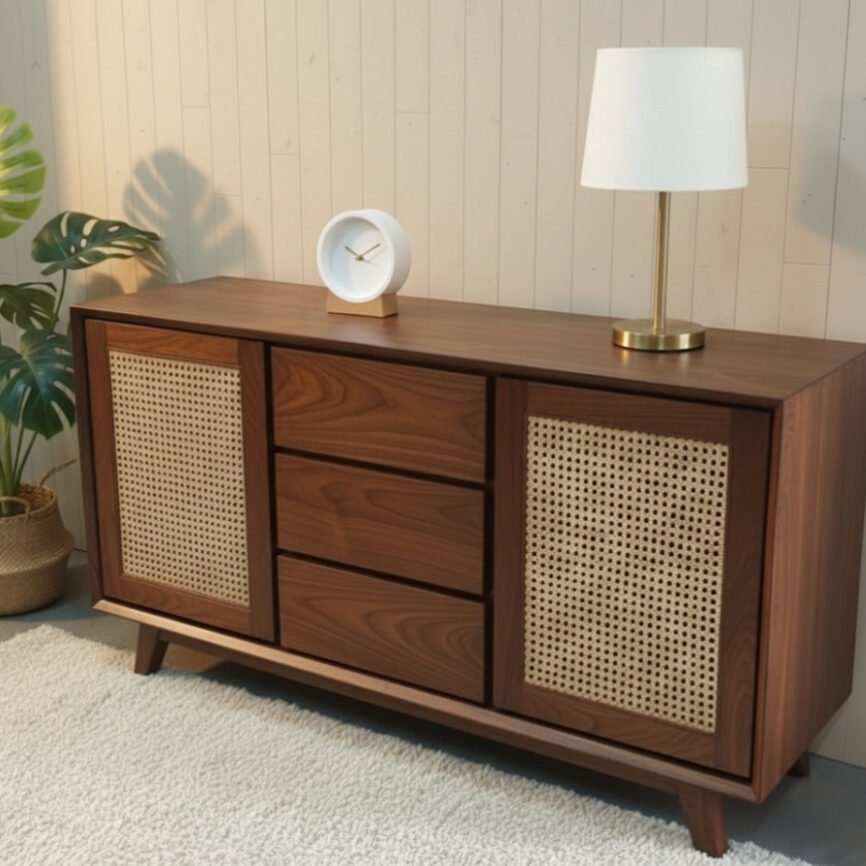
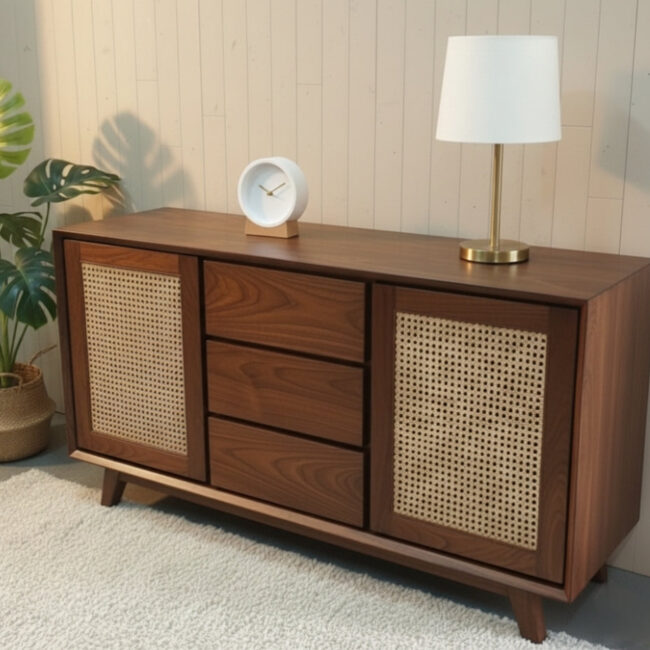
This is the one that stops people mid-scroll. Solid teak wood with woven rattan panel detailing on the doors. The rattan adds texture and visual depth that pure wood cannot achieve on its own. When light catches the weave, the surface shifts between shadow and warmth in a way that flat panels simply do not. Dimensions: 160 x 45 x 75 cm. Generous internal storage with both shelved and open compartments. The rattan detailing is not decorative filler. It serves a practical purpose: the weave allows air to circulate inside the cabinet, which matters in Malaysia’s humidity. Tableware, linens, and stored items stay fresher because moisture does not build up behind sealed doors the way it does in fully enclosed cabinets. This is the sideboard for dining rooms with natural light, tropical-styled homes, Airbnb properties that need a signature piece, and anyone who wants their storage furniture to have presence without heaviness.
LCS Breeze Teak Wood Sideboard
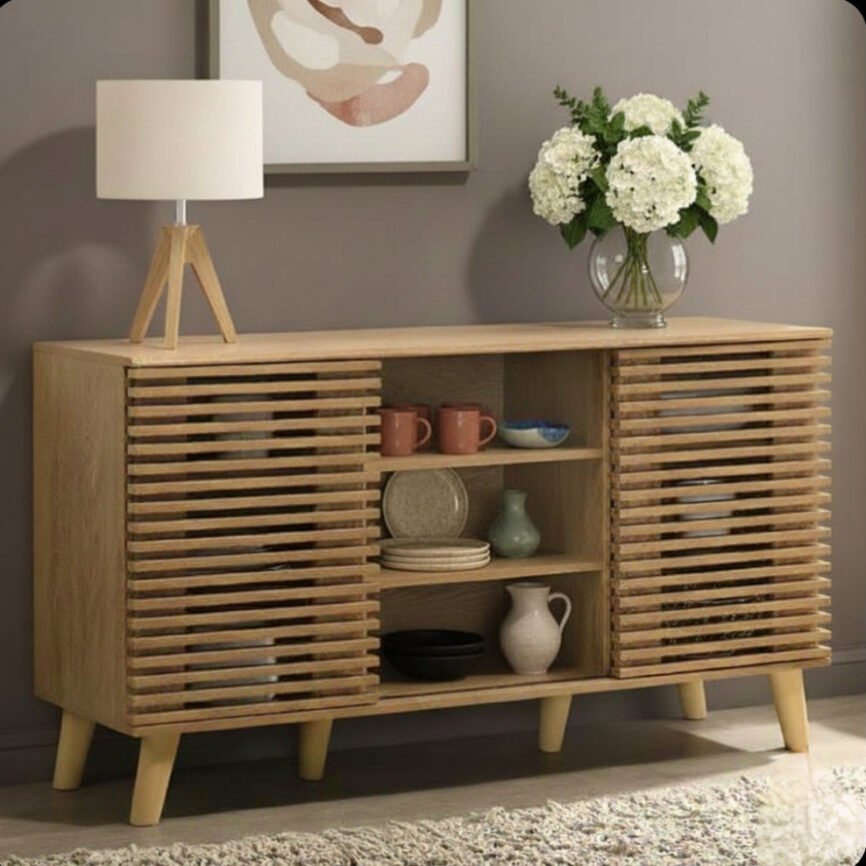
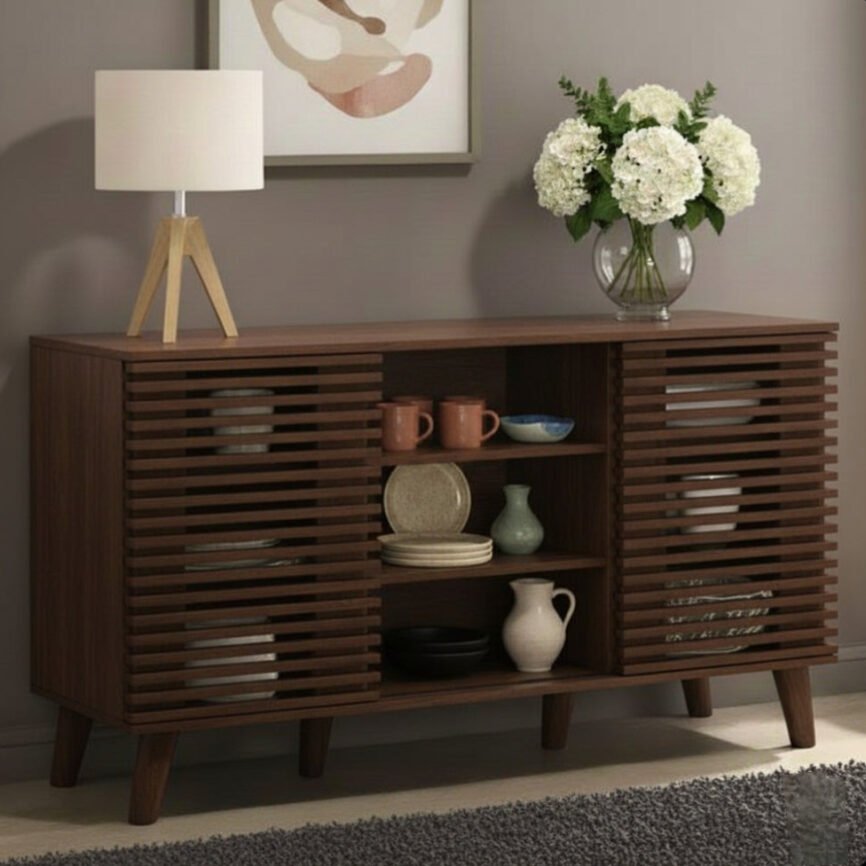
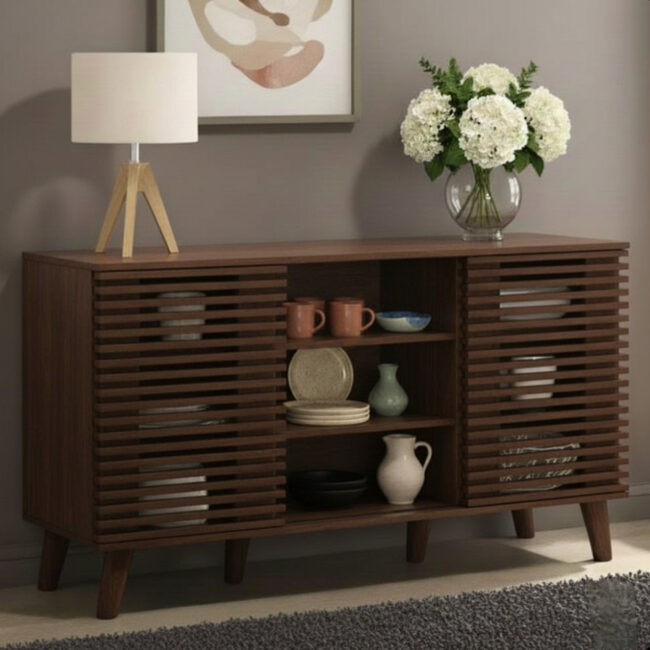
Solid teak with sliding louver doors. The louvers give this piece a mid-century, Scandinavian quality that sits beautifully in modern apartments and minimalist interiors. Sliding doors mean you never have to worry about clearance space in front of the cabinet. Nothing swings open into the walkway. Nothing blocks a chair. Dimensions: L140 x D40 x H76 cm. Combines open display shelves with enclosed storage behind the sliding doors. The open shelving section is the detail that elevates this design. Most sideboards give you either open display or closed storage. The LCS Breeze gives you both in one piece. Display your favourite objects, books, or a small plant in the open section. Keep everything else hidden behind the louvers. At 140 cm wide and 40 cm deep, this is also the most compact option in the range. If your wall is tight, your hallway is narrow, or your condo living area does not have room for a full 180 cm piece, the LCS Breeze fits where others cannot.
Breeze Teak Wood Sideboard
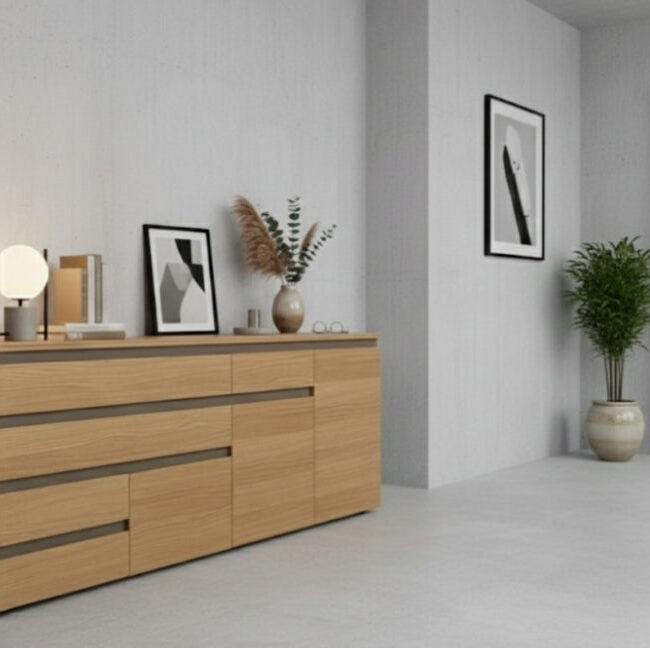
The largest and most straightforward design. Premium solid teak with clean lines, spacious internal storage, and a refined finish that lets the wood grain do all the talking. No rattan. No louvers. Just teak, doing what teak does best. Dimensions: L180 x D45 x H75 cm. This is also the only model currently available in alternative wood species. If you want the same design in Balau or rubber wood instead of teak, we can build it. Balau offers a darker, denser grain with excellent humidity resistance. Rubber wood provides a lighter, more uniform tone at a lower price point while still being solid hardwood, not engineered board. Learn more about all our timber options on the materials we use page. For larger walls, we extend this design beyond 180 cm. Some of our hotel and restaurant projects have required sideboards at 220 or 240 cm to fill reception areas and private dining rooms. The construction method scales without compromising stability because solid wood handles width the way particleboard cannot.
Why Solid Teak Sideboards Outlast Everything Else in This Climate
A sideboard sits against a wall. Often an exterior wall. In a Malaysian home, that wall absorbs heat during the day and releases it slowly through the night. The air behind the sideboard is warmer and more humid than the rest of the room. This is the micro-environment your sideboard lives in, permanently. MDF and particleboard fail here first. The back panel, the part pressed closest to that warm, humid wall, starts to soften and bow. You will not see it happening because it faces the wall. By the time you notice, the entire structure has shifted. Doors no longer close properly. The top surface develops a slight wave. The piece looks tired in a way that no amount of cleaning or rearranging can fix. Teak does not respond to humidity this way. The natural oils inside the grain structure act as a built-in moisture barrier. The wood expands and contracts fractionally with seasonal changes, but it returns to shape. It does not delaminate. It does not soften. The joints stay tight because teak holds fasteners with real mechanical grip, not the crumbly friction that particleboard offers. This is not a premium upsell. It is a material decision based on how buildings work in this part of the world. If your home has consistent 24-hour air conditioning in every room, MDF might hold up for a few years. If you live the way most Malaysians actually live, with windows open part of the day, air conditioning running part of the day, and outdoor humidity that regularly exceeds 80 percent, solid teak is the only material that will still look and function properly in year five, year ten, and beyond.
Sideboards for Living Rooms, Dining Rooms, Hallways, and Bedrooms
The same sideboard can work in four different rooms depending on what you put inside it and on top of it. The piece does not change. The context does. Sideboards in the living room. This is where sideboards are most commonly placed. Against the longest open wall, often opposite the sofa or beside the TV console. A living room sideboard typically stores books, photo albums, games, stationery, chargers, and the miscellaneous household items that accumulate. The top surface holds a lamp, framed photos, a vase, or a curated display that sets the visual tone of the room. Sideboards in the dining room. Place it against the wall closest to the dining table. Store tableware, serving bowls, napkins, candles, and bottles inside. During meals, the top surface becomes a serving station. Between meals, it displays a centrepiece, artwork, or a mirror that makes the dining area feel more spacious. The Rattan Berlin with its breathable weave is particularly well suited to dining rooms where you store linens and ceramics. Sideboards in hallways and entryways. A narrow sideboard in the entryway solves the keys-wallet-phone problem permanently. Everything has a drawer. The top surface holds a tray for daily essentials and a mirror or artwork above it that makes the first thing guests see feel considered and intentional. The LCS Breeze at 40 cm deep is shallow enough for most Malaysian hallways without blocking the walkway. Sideboards in bedrooms. Not everyone thinks to put a sideboard in a bedroom, but it works remarkably well as a low dresser alternative. Fold sweaters, scarves, and accessories into the drawers. Use the top surface for a jewellery tray, a perfume collection, or a lamp and a stack of books. The lower height compared to a traditional dresser keeps the room feeling open and uncluttered.
Custom Sideboards Built to Your Wall
This is where the conversation gets specific, and where the difference between ordering online and working with us becomes clear. You send us your wall measurement. Not the sideboard size you think you want. The wall. We need to see what we are working with before we recommend dimensions. Then we ask what goes inside. Tableware for twelve? A vinyl collection? Office paperwork and a printer you want hidden? The internal layout follows the contents, not a template. Then we discuss the finish. Natural teak with its warm golden tone. A darker stain to match existing furniture. A whitewashed or grey finish for lighter interiors. The Breeze model also offers Balau or rubber wood as base material alternatives, if teak is not the right fit for your project. Then we build it. Teak components are designed by our team and sourced through our supply partners. Any metal structural elements are fabricated in-house at our Shah Alam workshop. The result is a sideboard that fits your wall, holds your things, matches your room, and does not exist anywhere else. Custom sizing does not mean a six-month wait. It means we build your piece instead of pulling one from a warehouse. Lead times are discussed during the quoting stage and depend on the complexity of the design.
Sideboards for Hotels, Restaurants, and Commercial Interiors
In a hotel room, the sideboard replaces the generic luggage bench and mini-bar unit with something that looks intentional and stores more. Guests use the surface for personal items. Housekeeping uses the storage for amenities and extras. The piece earns its space in a way that single-purpose furniture never does. In a restaurant, sideboards serve as service stations, wine displays, and room dividers. The length and low height create natural zones in an open dining room without building walls or adding screens. We supply sideboards for commercial fit-outs through our B2B solutions service. Consistent quality across every unit in an order. Custom dimensions for each room type. Finishes that match your interior specification sheet. We work from your designer’s drawings or develop the design through our custom design service.
Frequently Asked Questions
What is the difference between a sideboard, a buffet, and a credenza?
They are close relatives. A sideboard is a long, low cabinet with doors and sometimes drawers, originally designed for dining rooms but now used everywhere. A buffet is functionally identical, often with a hutch or upper shelf. A credenza is typically slightly lower and was originally an office piece, though the word is now used interchangeably with sideboard in residential settings. At Samz Design, we call ours sideboards because that is how most people in Malaysia search for them. The piece itself can serve any of these roles.
What size sideboard do I need?
Start with your wall. A sideboard that fills 60 to 80 percent of the wall width behind it looks proportional and intentional. A sideboard that fills less than half the wall looks lost. Our three standard widths are 140, 160, and 180 cm, but we build to any width your wall requires. Depth is typically 40 to 45 cm, which keeps the piece close to the wall without protruding into the room.
Can I use a sideboard instead of a TV console?
Absolutely. A 180 cm sideboard at 75 cm height works well beneath a wall-mounted TV. You get significantly more storage than a dedicated TV console, plus a wider display surface. If you need cable routing for media devices, we can add that during the build.
Is teak the only wood option?
No. Our Breeze model is also available in Balau (a dense tropical hardwood with a darker grain) and rubber wood (a lighter, more affordable solid wood). We recommend teak for its superior humidity resistance and longevity, but the alternative woods offer solid construction at different price points.
Will rattan hold up in Malaysian humidity?
Natural rattan has been used in Southeast Asian furniture for centuries precisely because it handles tropical humidity well. It is flexible, breathable, and does not crack or swell the way rigid materials can. The rattan weave on our Berlin sideboard also improves air circulation inside the cabinet, reducing moisture buildup around stored items.
How deep should a sideboard be for a hallway?
For a standard Malaysian hallway or corridor, a sideboard between 30 and 40 cm deep works best. This keeps the piece tight to the wall without blocking the walkway. Our LCS Breeze at 40 cm is designed for exactly this. If your hallway is narrower, we can build a custom version at 30 or 35 cm depth.
CATEGORIES
Showing all 3 resultsSorted by price: low to high